Singapore’s WSH (Work at Height) Regulations 2026: Essential Updates for Managers
WSH (Work at Height) Regulations 2026
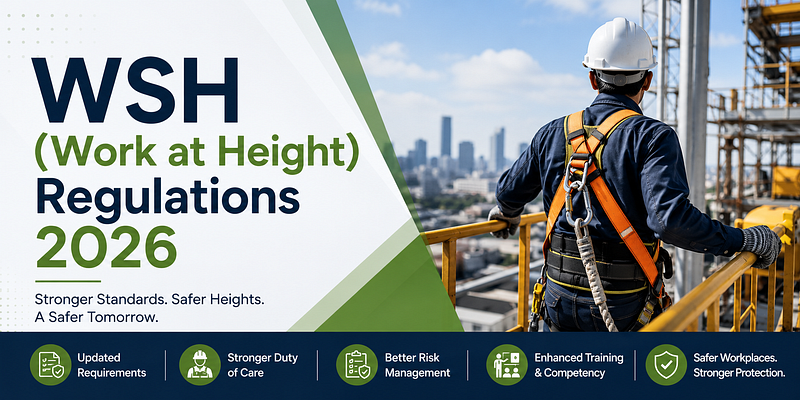
Singapore’s built environment and industrial sectors are advancing rapidly, but this progress brings intensified regulatory oversight. In 2026, the Ministry of Manpower (MOM) has significantly tightened enforcement surrounding the Workplace Safety and Health (Work at Heights) Regulations. For project managers, WSH officers and site supervisors, relying on outdated compliance checklists is no longer sufficient.
The current regulatory landscape demands proactive hazard management and strict adherence to new technological and procedural mandates. Here is a detailed breakdown of the crucial updates managers must implement this year to protect their workforce and their operations.
Mandatory Video Surveillance Systems (VSS) for High-Risk Areas
One of the most impactful shifts in 2026 is the stringent requirement for continuous site monitoring. Construction worksites with a contract value of $5 million or more are now mandated to deploy Video Surveillance Systems (VSS) at high-risk locations. This specifically targets areas where personnel are exposed to fall risks exceeding 2 meters. Managers must ensure these systems are actively recording and that the footage is easily accessible for MOM audits. This move firmly transitions site safety from periodic physical inspections to persistent visual accountability.
Technology-Driven Enforcement and Drone Audits
MOM has heavily upgraded its inspection capabilities. The ministry now actively utilizes data analytics, drone surveillance, and real-time sensor data to identify and target high-risk workplaces. This means compliance checks are more frequent, less predictable, and highly sophisticated. Managers must operate under the assumption that external entities are constantly evaluating their structural barriers, edge protection, and individual fall arrest systems. Maintaining continuous, seamless compliance is the only viable strategy.
Heightened Rigidity in Fall Prevention Plans (FPP)
A site-specific Fall Prevention Plan (FPP) has always been a legal necessity, but the scrutiny applied to these documents has intensified. An FPP can no longer function as a generic, copy-pasted template. In 2026, managers must ensure that their FPP clearly defines the Hierarchy of Control, explicitly prioritizing engineering controls — such as guardrails, covers for openings, and travel restraints — over personal protective equipment (PPE). Furthermore, the Permit-to-Work (PTW) system for hazardous work at height (exceeding 3 meters) requires rigorous, stage-by-stage documentation, verified on-site by an appointed WSH Safety Assessor before any activity commences.
Validating the Competent Person and Workforce Certifications
Under the WSH Act, the responsibility to provide adequate safety training rests squarely on the employer and the principal. Managers are strictly liable for verifying that every worker, supervisor, and safety assessor possesses valid, up-to-date certifications. The regulatory focus heavily emphasizes the role of the “Competent Person” — individuals specifically trained to inspect scaffolding, evaluate permanent anchor points, and execute emergency rescue protocols within the critical “Golden Hour” of suspension trauma.
Securing Compliance with Greensafe International
Navigating these strict 2026 updates requires precise, industry-aligned training. Managers must equip their teams with the exact technical skills demanded by the current legislation to avoid severe penalties, including Stop Work Orders (SWO) and demerit points.
This is where partnering with an established training provider becomes a strategic asset. Greensafe International delivers comprehensive, MOM-aligned Work at Height training designed specifically for the Singaporean regulatory environment. Their specialized Manage Work At Height courses provide supervisors and managers with the actionable insights required to draft robust Fall Prevention Plans, execute flawless PTW systems, and conduct rigorous risk assessments.
By integrating Greensafe International into your corporate training matrix, you ensure your workforce operates not just with compliance, but with absolute operational confidence. Protecting your team and your company’s operational license requires uncompromising standards; ensure your personnel hold the required competencies for 2026 and beyond.


Comments
Post a Comment